


Damp-proofing St Helens and Warrington
Gud Developments are specialists in dampproofing with over 25 years of experience, Gud can offer a full range or services with regards to dampproofing. Initially if there is a problem with damp within the property, our dampproof specialist will visit the property and ascertain as to why there is damp within the property. If required for mortgage or insurance purposes we can provide a full report as to why there is damp within the property. This can range from a full visual inpection of the property or a quick and efficient test of the properties internal brickwork. This will include drilling into the brickwork in several of the ground floor walls in order to obtain a dust sample. This sample is then put with a chemical that will calculate the true moisture content of the brick and ultimately will be able to give a reading form 0 to 5 that will establish whether or not the damp course has actually failed.
On occasion other factors may give the assumption there is damp within the property, when in fact upon further investigation the damp course may not need replacing and the other factors may need adressing.
Once established whether the damp course needs replacing, we offer 3 equally succesfull damp courses. One is a drill and injectl damp course whereby the existing plaster to the walls is knocked off to 1m heigh and the damp course solution is pumped into the walls. The second is a cream damp course.
The other is an electro-osmotic damp proof course. Which includes using an electrical current behind the skirting board to prevent any damp within the property.
All 3 damp proof courses do come with a 25 year guarantee and these guarantees are now insurance backed. We also offer a tanking service for basements.
Below are images and descriptions of the stages of a cream damp proof course. We are an approved Wykamol Group dpc installer.
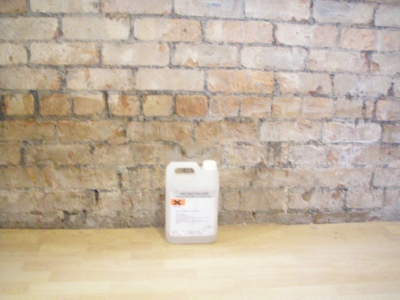
After removing the plaster to 1 metre high. The wall is then brushed and painted with a salt neutraliser.
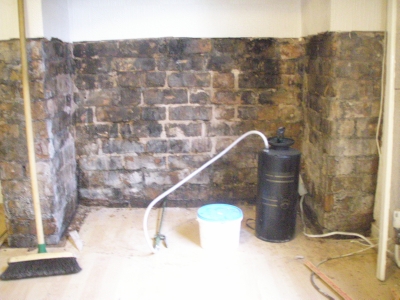
The next stage is to inject the Wykamol Ultracure silicone cream.
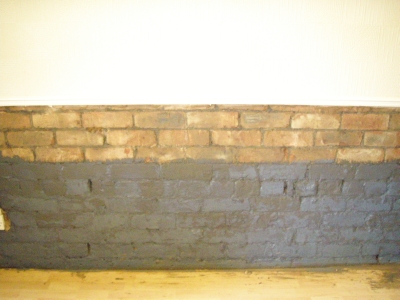
This stage involves painting 2 coats of SBR on the wall to seal the wall from penetrating damp and stop any salts coming through to the new plaster.
This stage involves using washed plastering sand and waterproofer and cement and applying one coat of scratchcoat and then a further topcoat. Image to follow.
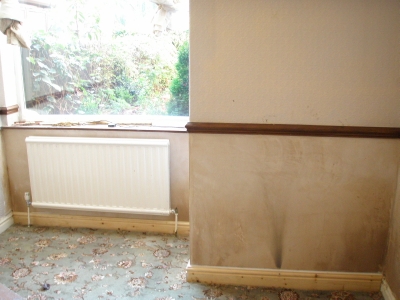
This involves skimming the walls flat and fitting new treated shirting boards.
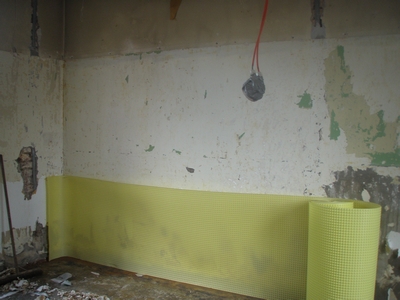
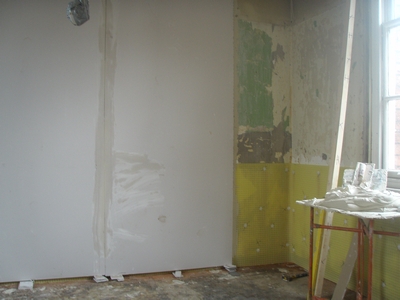
We recommend fitting a damp proof membrane for old terrace properties before dry lining. Over time the plasterboards will absorb moisture through the brickwork and the membrane will prevent any futher moisture coming from the brickwork.
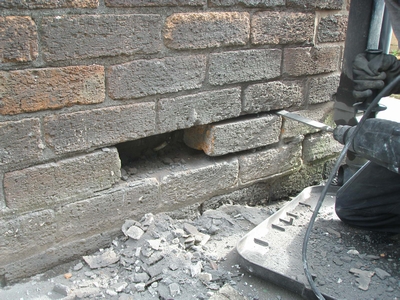
This procedure is used to clean out the cavities between the two skins of brickwork. It is not always necessary to replace the damp course when there are signs such as several dark patches. This could be due to a build up of loose rubble and debris within the cavity and can be easily resolved through removing some of the lower course bricks and giving the cavity a thorough clean.
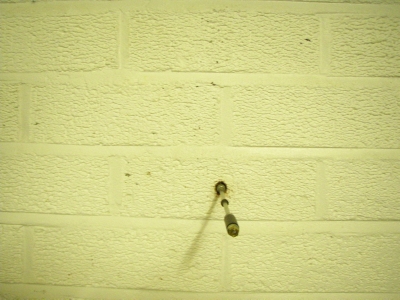
We offer a survey for wall ties which involves finding an existing tie with a metal detector, carefully taking out a brick to remove the wall tie in order to ascertain whether the ties need replacing. If the tie is extremely corroded replacement wall ties need to be installed. The image shows a tie being fitted to an external wall. We are an approved Pam tie installer. We also provide a 30 year guarantee and an insurance backed guarantee.
We also carry out a treatment for dry and wet rot in timber floors and timber roofs. Images to follow


